11 minute read…
Group dog walking can look simple from the outside. A dog walker arrives, collects a few dogs, heads off for a walk and returns them home tired and happy. Sometimes it’s absolutely that straightforward. But, I’ll be honest, it often isn’t!
The reality is that successful group walks rely on far more than just throwing any combination of dogs together and hoping for the best.
Some of the most common misconceptions I come across is the idea that all dogs should enjoy group walks, need them for socialisation, get along with every other dog, and slot easily into any group. But like us, dogs are individuals – they have different personalities, preferences, life experiences and social skills. What works brilliantly for one dog might just not be suitable for another. And that’s really ok.
Not every dog is suited to group walks
This is often the hardest thing for owners to hear, particularly when they know their dog is friendly and loving at home or likes to ‘play’ with other dogs when they’re out and about.
But being a lovely dog does not automatically mean a dog will enjoy or benefit from a group environment. Some dogs thrive in groups, while others find them overwhelming. Some prefer one or two close canine friends, some are anxious around unfamiliar dogs and others become overexcited and struggle to regulate themselves when surrounded by multiple dogs. None of this means there’s anything wrong with the dog.
As humans, we tend to place a lot of value on sociability, but dogs exist on a spectrum just like we do. Many are perfectly happy coexisting alongside other dogs without wanting to interact with them, some are selective about their friends, and some just genuinely prefer their own space. A dog doesn’t need to love every dog they meet to be happy or fulfilled.
Even dogs that enjoy the company of other dogs won’t necessarily enjoy the company of every dog. Dogs gather information through body language, scent, movement and past experiences in ways that are often invisible to us. Sometimes dogs just don’t ‘click’, and that’s ok.
This is why compatibility matters so much. Successful group walks aren’t about putting together whichever dogs happen to live closest together (though of course, location is something you have to take into account to reduce their travel time). They’re about personalities, play styles, confidence levels, energy levels and communication styles. Sometimes you can find these things matching in breeds, sometimes combinations might not be as obvious – for example, I have a four-year-old, female, mud-diving Golden Retriever who loves walking with a 12-year-old, chaotic male terrier and vice versa. I mean they are literally little and large.
The best groups develop naturally over time, with dogs learning each other’s habits, understanding each other’s boundaries and feeling comfortable in each other’s company.
Keeping routine
A lot of dogs can thrive on routine and predictability. Knowing who they are walking with and what to expect can help them feel safe and secure. Predictability often reduces uncertainty. It can lower anxiety, improve confidence and help dogs make better choices. Because I’ve got to know so many of my dogs on a deeply personal level, I know that many of the dogs I care for prefer stable groups rather than constantly changing combinations of dogs; this is just one of the reasons why I have a one walk a week minimum booking policy, with many dogs tending to have fixed days – it keeps things consistent for everyone.
When dogs repeatedly walk alongside familiar companions, their relationships have the opportunity to develop naturally. They’ve all learned each other’s communication styles and I can see how comfortable they are together. Obviously life happens, and sometimes there are changes, but in general I want the dogs in my care to know what they’re turning up to because I know it helps keep them relaxed.
It’s not to say that dogs aren’t resilient, some dogs are absolutely fine with being paired up in different combinations, of course they are, and I always take that into account too. That’s why it’s important to me to personalise my approach with every dog.
Why group walks can’t be dog training sessions
This may be a difficult thing to hear, but a group walk is not the place to teach a dog social skills from scratch. And this isn’t because I don’t want to help, it’s just that group walks are rarely the right learning environment for dogs who are struggling with socialisation.
Dogs cannot learn effectively when they feel unsafe, overwhelmed, stressed or highly aroused and group walks are naturally stimulating environments. There are other dogs, interesting smells, wildlife, people and lots of distractions. If a dog is already struggling with calmness, disengagement or social skills, putting all these things together is setting them up for failure – dogs can’t learn when they’re over aroused or over stimulated.
It’s also really important to talk about the practicalities. When I have multiple dogs, I’ve got to focus my attention on their welfare and safety. I’m always monitoring body language, managing the environment, assessing risk, watching for changes in behaviour and making sure everyone’s comfortable and thriving. It’s just not possible to give one dog the type of 1-1 attention it needs for training when they are part of a group.
Any trainer or behaviourist worth their salt will tell you that training is most successful when the foundations are built in quieter, less stimulating environments first and then gradually generalised into more ‘challenging’ situations. It’s really unfair to put a dog into the situation where everything’s exciting and then expect them to learn – these foundations need to be done first. That’s why I don’t take on dogs without lead manners into group walks for example – working with them on things like loose lead walking needs to be done outside these settings, it’s unfair on the dog (and the dog walker!) to teach them these skills when the environment is going to be challenging for them to learn in.
Group walks are not a substitute for socialisation
Socialisation is one of the most misunderstood concepts in dog ownership; many people assume socialisation means your dog meeting as many dogs as possible.
In reality, good socialisation is about helping a dog feel comfortable and safe around other dogs. For some dogs, that might absolutely include play and group adventures, but for others it might just mean them being able to share space calmly with others dogs, or walking past them without worrying.
Repeated exposure doesn’t create social skills. In fact, putting a dog into situations they are not prepared for can sometimes have the opposite effect. One negative experience can have a lasting impact on how a dog feels about future interactions.
Dogs are born with the foundations of canine communication, but appropriate social interactions still rely on a range of skills including calmness, disengagement, confidence and emotional regulation. If those foundations aren’t in place yet, a group walk may not be the right starting point for them.
Where appropriate, I am always happy to work alongside owners and qualified trainers or behaviourists that I respect and admire to support a dog’s progress. It’s important to recognise that a dog walker and a trainer/behaviourist perform very different roles, and a group walk should never be expected to replace a structured behaviour modification or training plan.
My assessment process
Every dog is assessed as an individual with no standard formula or fixed timeline.
The process always starts with a free meet and greet so I can get to know both you and your dog. From there, if it looks like your dog and I might be the right fit for each other, the next step is usually a paid one-to-one trial walk.
Following that, I review what I’ve observed and decide on the most appropriate next step. For some dogs, that might mean moving straight into a test group, for others, it might involve another one-to-one walk, an introduction to a calm and neutral dog I already know well, or a more gradual integration process. Every stage is always reviewed and discussed before moving on to the next.
Some dogs settle quickly. Others need more time – the process is tailored to your dog rather than following a one-size-fits-all approach.
Sometimes I have to say no, and, trust me, turning down a dog is one of the least enjoyable parts of my job. But honesty is part of responsible dog care, and I will always put their welfare and the welfare of the other dogs I care for first. If I don’t believe a dog will enjoy a particular group, or if I think a group walk would be unfair on that dog, I will say so.
I understand that it can sometimes feel personal but believe me when I say, it’s never a judgement on the dog and it definitely isn’t a criticism of the owner. It only means that, based on what I’ve observed, I believe that either groups aren’t suitable at that moment in time or the dogs and dynamics I have in my groups aren’t suitable.
Sometimes that decision is permanent if I genuinely don’t think the dog will thrive with other dogs, sometimes it’s temporary – sometimes a dog just needs more time, more confidence, more training or a different type of support before joining a group environment.
My responsibility is always to the welfare of the dog in front of me, not to filling a space on a walk. I don’t want any of my dogs to ‘survive’ a group walk, I want them to thrive – they have such short lives in the grand scheme of things that I want their time with me to be the best time ever.
Why I choose to walk a maximum of four dogs
My insurance allows me to walk up to six dogs at a time but personally, I choose not to.
That’s not because walking larger groups is inherently wrong. Different walkers structure their services differently and many do so very successfully.
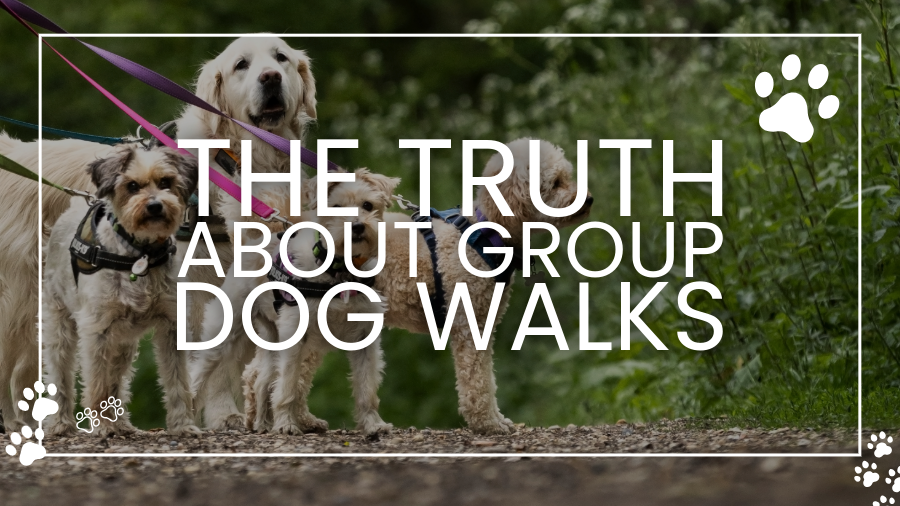
For me, keeping group sizes smaller just allows me to maintain the style of service I want to provide. Personally, I find that smaller groups make it easier to observe subtle body language, monitor individual welfare, support appropriate interactions and adapt the walk to the needs of the dogs present that day. Of course it also allows me to make sure everyone’s poo is picked up (trust me, it’s a challenge when you have four off lead dogs that decide to poo at the same time in different places!).
I also have a car, rather than a van. That’s just personal preference, but my car is set up so that four dogs can be separated from each other and transported safely and legally. I even had a special guard engineered to separate my back seat – I prefer dogs to not have access to each other when travelling. Vehicles are a small, confined space, excitement can be high, or one dog could just be having an off day; keeping them separate minimises risk to each other.
Walking a maximum of four dogs at a time also allows me to be selective about my group composition. For my business, it feels like the right balance.
No toys doesn’t mean no fun
People are sometimes surprised to learn that I don’t take toys out on group walks, but there’s several reasons for this.
Firstly, toys can increase excitement levels and arousal, which isn’t always helpful in a group environment. Secondly, toys can create competition between dogs and, in some cases, lead to resource guarding or conflict. But most importantly, dogs gain enormous value from being allowed to explore the world naturally, through sniffing – having toys around can take away from that.
I think everyone knows that dogs experience the world mostly through their noses. Their sense of smell is honestly unbelievable (people have about 5 – 6 million scent receptors, dogs have up to 300 million!) and they devote a huge amount of brain power to processing the information they gather when having a good old sniff. Sniffing is never a distraction from the walk, for lots of dogs, it’s one of the most enriching parts. A physically tired dog isn’t necessarily a fulfilled dog; dogs often gain more from an hour of exploration, sniffing and engagement with their environment than they do from repetitive, high-intensity games. This is because their mind is being exercised as well as their body,
Not all play is positive play
Ok, so I’m not the fun police I promise, but sometimes it’s appropriate to interrupt play out on walks. Good group walks aren’t about creating maximum excitement; they’re about creating positive experiences. That’s why I’ll often ask owner’s about a dog’s play style and preferences – many of my current dogs are happiest just exploring the environment around them, rather than engaging in lots of play.
Play can be abso-bloody-lutely amazing when it’s balanced, reciprocal and enjoyed by all dogs involved.
But not all play remains appropriate. Sometimes excitement escalates, sometimes one dog becomes overwhelmed and sometimes arousal levels rise to a point where sensible decision-making disappears. Part of my role is identifying those moments before they become a problem. So, this means I’m always watching body language and monitoring interactions, and yes, sometimes stepping in if I think it’s necessary.
I never want to stop dogs having fun, and I think you can probably see from my social content that my groups have a ball, I just want to ensure everyone is safe, happy and no one’s driving each other mad!
The right group matters more than the group itself
I’ve said it already, but dogs have such devastatingly short lives in the grand scheme of things, and because all of the dogs that I care for become my family too, I just want to do the absolute best by them.
A successful group walk isn’t about getting as many dogs together as possible, it’s about finding the right dogs for each other.
Some dogs will thrive in group walks. Some won’t. Some will need a little extra support before they get there. And some may never enjoy them at all.
The most important thing is finding an arrangement that allows your dog to feel safe, comfortable and genuinely happy. Because ultimately, that’s what good dog walking should be about.