7 minute read…
Every year, as soon as temperatures start rising in the UK, I see the same arguments again and again across social media platforms.
“It’s only 22 degrees.”
“They survive in Spain.”
“My dog loves sunbathing.”
“We walked at this temperature all the time when I was younger and dogs were fine.”
Discussions around dogs in hot weather in the UK tend to become oversimplified very quickly. Temperature gets reduced to the only factor, people compare their own comfort levels to their dog’s and social media turns a complex physiological issue into an argument about whether people are being ‘overdramatic’ or not. The hate I see waged towards those advocating for dogs in hot weather is unnecessary and uninformed.
A dog’s ability to cope in warmer weather is influenced by lots of interacting factors – humidity, airflow, acclimatisation, body condition, breed, skull shape, coat type, exercise intensity, age, overall fitness…Even then, there is huge individual variation between dogs.
This is one of the reasons why there is no universally ‘safe’ walking temperature that applies equally to every dog in every situation. But there are definitely conditions that are far more dangerous than others.
Heatstroke isn’t just about hot cars
Public awareness campaigns around dogs in hot cars have been massively important over the years. Heatstroke absolutely can and does kill dogs left in vehicles. Seeing a dog left in a hot car seems to unite people a little more in anger than seeing a dog being walked on a hot pavement – somehow that seems to be more divisive.
But research shows that it’s the dogs being exercised we need to start turning our attention to.
A 2020 VetCompass study analysing veterinary records from more than 905,000 dogs under UK primary veterinary care identified 395 heat-related illness (aka heatstroke) events in 2016. The study found that exercise was the most common trigger for heat-related illness in UK dogs, exceeding cases caused by vehicular confinement or environmental exposure alone.
It challenges the idea that heatstroke only becomes dangerous during extreme temperatures or obvious emergencies. Dogs do not need to be trapped in a boiling car to overheat.
They can overheat during walks, play sessions, hikes, running, training or high-arousal activity, particularly when environmental conditions make cooling hard for them.
Dogs don’t cool themselves like humans
Us humans rely heavily on sweating to regulate body temperature. I think many of us know by now that dogs do not.
Dogs have very limited sweat glands, primarily in the paw pads, so their main method of cooling is actually evaporative heat loss through panting. Basically, as air moves across the moist surfaces of their tongue, mouth and respiratory tract, heat dissipates through evaporation.
This is why panting increases during exercise and warm weather. It’s their body attempting to offload excess heat. The problem is that this cooling system of theirs becomes less efficient under certain environmental conditions.
So, for example, the more moisture already present in the air, the harder it becomes for evaporation to be effective. This means humidity can significantly impair a dog’s ability to cool themselves, even at temperatures many people would not immediately consider ‘dangerous’, and the UK has a pretty humid climate (we’re an island surrounded by water). This is one of the reasons dogs may appear to struggle more on a humid 18°C morning than on a drier 24°C evening.
“The UK climate is relatively humid compared to many other European countries because of the UK’s proximity to the ocean and the prevailing south-westerly winds which bring moist sea air over land.”
Meteorologist Dr Matthew Patterson
“What about dogs in hot countries?”
This is probably one of the most common responses whenever heat safety is discussed online, but it’s usually worded less politely!
Yes, of course dogs live in hot countries, and even hot, humid countries, but that argument is utterly oversimplified and ignores a lot of science.
First, it’s important to understand acclimatisation. Physiological adaptation to heat occurs gradually over time. A dog living in a consistently warm climate develops different coping mechanisms compared to a UK pet suddenly experiencing a short heatwave after months of cool weather.
Research shows acclimatisation can affect:
- Circulation
- Blood plasma volume
- Hydration balance
- Cardiovascular efficiency
- Resting body temperature
- Exercise tolerance in heat
Secondly, canine behaviour tends to change and adapt in hot climates too. In many hotter countries, dogs naturally reduce activity during peak daytime temperatures. They rest in shade, seek airflow, remain on cooler surfaces and become more active early in the morning or later in the evening.
Some people argue about ‘feral’ dog coping well abroad; but the truth is, many free-roaming or village dogs are also very different from modern UK companion breeds. Landrace dogs* in hotter climates have often undergone generations of natural selection – you see leaner body types, longer muzzles, lighter frames and greater heat tolerance. Compare that to some of our modern companion breeds bred selectively for different types of physical characteristics – like shortened noses, denser coats or body masses that are on the heavier side.
The comparison just isn’t equal I’m afraid. Veterinary literature from warmer countries clearly shows that dogs do still suffer heat-related illness. They’re not exempt from it.
Humans survive in deserts too. That does not mean every unacclimatised person could safely run an ultramarathon through the Sahara.
* a naturally evolved, locally adapted population of canines that developed in response to a specific geographic environment, climate, and human culture.
Breed, body shape and anatomy
The VetCompass study I mentioned earlier, also identified quite a few significant risk factors associated with heat-related illness in dogs.
Brachycephalic (flat-faced) breeds (think Bulldogs, French Bulldogs, Pugs etc) showed substantially increased odds of heat-related illness compared to mesocephalic breeds (dogs with proportionally shaped heads). For example, Bulldogs had almost fourteen times the odds of heat-related illness compared to Labrador Retrievers in the study population.
This is not particularly surprising when you think about their physiology and how dogs cool themselves.
Remember panting? It relies on air moving over the wet surfaces of their tongue and airways so heat can escape through evaporation. Dogs with very short noses and narrowed airways already struggle to move air efficiently, so they’re at a disadvantage even before hot weather or exercise. The VetCompass study specifically notes that brachycephalic dogs have “reduced heat dissipation mechanisms” because of their airway anatomy.
The study also found that body size had an impact. Dogs weighing over 50kg had more than three times the odds of heat-related illness compared to dogs under 10kg.
Again, makes sense, heavier dogs generate and retain more heat during exercise. And when they’re carrying more weight than they should, overweight dogs may also struggle more because excess body fat makes it harder for the body to get rid of heat and acts a bit like extra insulation.
Age was a factor too – they saw an increased risk in older dogs (they said because they’re more likely to have pre-existing conditions that limit their ability to dissipate heat effectively). But really interestingly, when it came to gender, they found that male dogs develop higher body temperature post-exercise and were overrepresented in the data in cases of heatstroke presenting to veterinary hospitals. Boys get hotter.
They also discussed that coat type could contribute too. The study highlighted increased risk in pedigree breeds like Chow Chows and Golden Retrievers, suggesting their dense coats may worsen heat retention under certain conditions. This one’s an interesting finding because I often see the argument online that breeds with denser coats are ‘insulated’ from the heat. It’s perhaps a topic for a whole other post but, leading expert in this area, Dr David Marlin, shared this online:
“One of the most persistent myths is that a dog’s coat “insulates against the heat.” This is both true and misleading. A dog’s coat can protect against external heat, but only if the dog itself isn’t continually generating internal heat, which, of course, it is.
Just like a well-insulated house will trap heat from a fire burning inside, a dog’s coat holds in the heat generated by its metabolism. This means that in hot weather, the coat can actually slow down the dog’s ability to lose heat, not help it stay cool. The less coat they have, the cooler they will be.”
Some dogs will keep going long past the point they should stop
One of the most dangerous misconceptions around heat is the idea that a dog would stop if they were too hot. Of course some dogs do. But not all.
There are dogs who will continue chasing balls, running or playing because they are highly driven, over-aroused or just desperate to continue interacting with their owner.
Dogs don’t understand heatstroke. They don’t understand exertional collapse. They don’t understand long-term organ damage. They are relying on us to make sensible decisions on their behalf.
Other things to look out for
I’ll talk about symptoms of heatstroke in a bit, but first, I want to draw your attention to something else – their tongues. A dog’s tongue can actually give you really useful information about how hard their body is working to cool itself.
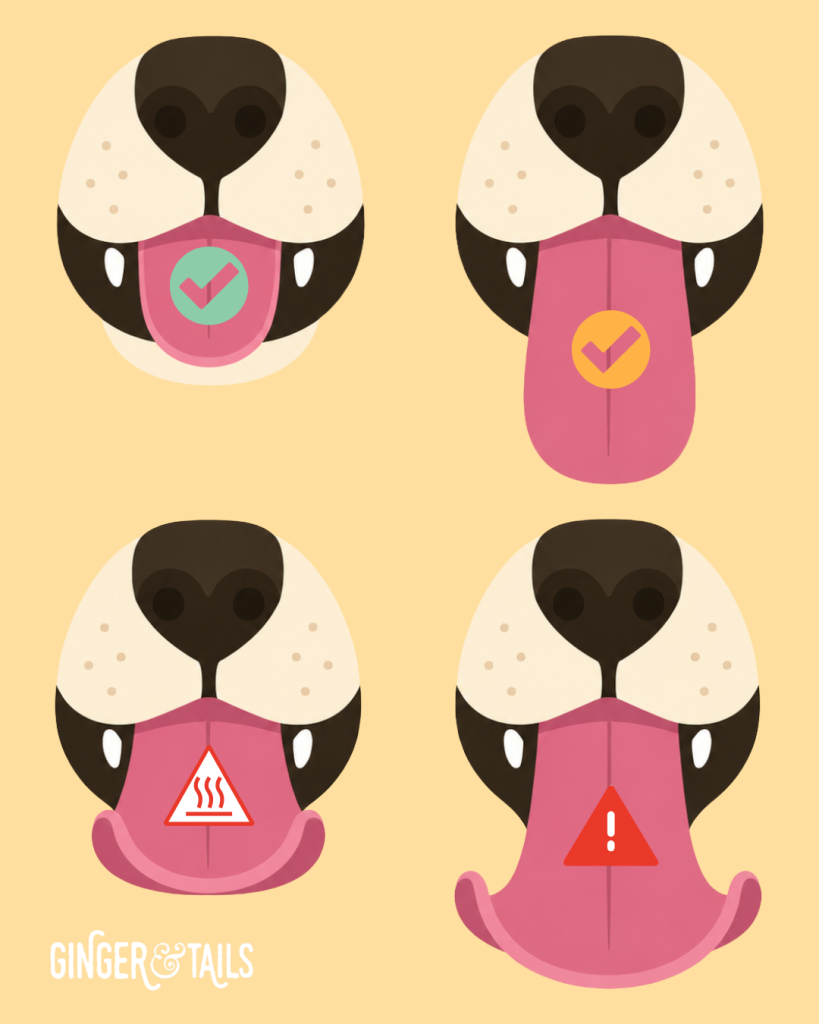
As their body temperature rises, a dog’s tongue will change shape to increase its surface area – the bigger the surface area, the more chance of the evaporative cooling I talked about earlier. It’s an amazing piece of physiology. The dog’s body is trying to create more opportunity for heat to escape.
So…what to look for…
A relaxed tongue sitting loosely in the mouth generally indicates a dog regulating its temperature effectively. Tick.
As heat load increases, the tongue may become longer, flatter or spoon-shaped. This often goes along with more persistent panting, tighter facial muscles and an increased difficulty recovering during rest periods.
A dramatically curled or cupped ‘ladle-shaped’ tongue can indicate a dog is struggling significantly with thermoregulation. Owners sometimes misinterpret the accompanying tight facial expression as a, “Oh look, they’re smiling!”, when in reality the dog may be overheating badly and you need to take action.
As with anything, context is always really important, and indicators like this should always be looked at as part of the bigger picture (humidity, ambient temperature, breed, exercise intensity, recovery speed etc), but if you can start recognising signs like this, you can intervene earlier, before it becomes a medical emergency.
Recognising heatstroke
Heatstroke is a veterinary emergency and can progress really rapidly.
Clinical signs may include:
- Excessive or frantic panting
- Thick drool or hypersalivation
- Vomiting or diarrhoea
- Lethargy or reluctance to move
- Wobbliness or collapse
- Bright red, pale or muddy gums
- Glazed eyes
- Disorientation
- Seizures in severe cases
Importantly, dogs do not always deteriorate in a neat line. Some compensate really well until they suddenly just can’t anymore.
What to do if you suspect heatstroke
If you think your dog has heatstroke or is developing it, stop exercise immediately (if that’s what you’re doing) and move them somewhere cool and shaded.
Young, healthy dogs can be immersed in cool water. For older dogs or dogs with underlying health conditions the evaporative cooling method is better – pouring water of any temperature that is cooler than your dog over them and combining it with air movement from a breeze, fan or air conditioning.
Offer small amounts of cool water if the dog is conscious and able to drink safely.
Don’t wrap dogs in wet towels or blankets, this is outdated and potentially dangerous advice – it can trap heat against the body and make them hotter.
Most importantly, contact a vet urgently.
The rule is – cool then transport.
Even dogs that initially appear to recover can continue deteriorating afterwards as internal damage progresses. ALWAYS CONTACT A VET!
Final thoughts
Conversations about dogs in UK hot weather online are more often than not…emotional, defensive and strangely competitive (I’ve seen people boasting about the highest temperature they can take their dogs out in – it’s rage-baiting at its finest).
But understanding risk factors is not hysteria or ‘woke’ as I saw one person describe it! The science around heat-related illness in dogs is clear. Humidity matters. Breed matters. Bodyweight matters. Airway anatomy matters. Exercise matters. Acclimatisation matters.
I’ve said it before, there is no single ‘safe’ number that magically applies to every dog in every single environment, but there are temperatures when it certainly becomes a dangerous decision to take your dog out on a walk, and as a dog walker, I have a responsibility to put measures in place. Read my hot weather policy here.
Our dogs would follow us to the ends of the earth if they could. Let’s repay that love and loyalty by putting their welfare before our needs.